
 |
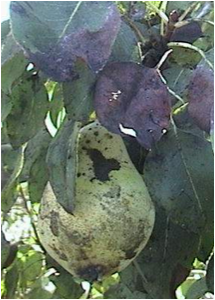
| Damage caused by sooty mold on fruits |
DESCRIPTION
Pear flea is a tiny insect (2.5-3 mm), with a short wide head and big eyes. The colors are orange-brown or brown-red with black spots. The head is triangular in shape. The rear pair of legs has been developed for jumping (adults only jump).
DAMAGE
Direct damage is reflected due to the sucking juices by the larvae of pear fleas, with fruits, leaves and young shoots, resulting in the weakening of trees and the development of small fruits ..
Indirect losses are reflected in the transfer of phytoplasma, the secretion of honeydew on fruit, leaves and young shoots. Of honey dew has settled sooty mold (genus Capnodium). The leaves turn black, reduces photosynthesis, weakening the plant, and for a stronger attack and die completely. The fruits are dirty and no longer have any economic value .
LIFE CYCLE
The key to good protection is knowledge of the life cycle of pests. The annual generation of 4-5 , wintering adult winter form, which appear in early October and last name in hidden places, under bark as individuals or in small groups. When the time available, and it is often already in January, the males fertilize the females that are ready for laying eggs. The main factor affecting the development of the start of oviposition temperature. It according to Nguyen, 1975, should two consecutive days to be greater than 10 ° C . From eggs deferred in the winter side with the movement of buds out young larvae, which feed on new shoots. From April to June appear adult summer forms that postpone much more eggs. Females lay eggs in the buds, young leaves, stems and the tips of the shoots. One female put down about 400 eggs (summer generation can defer up to 1,000 eggs and larvae appear after 7 days). Eggs pear fleas are light-yellow color , which aging becomes orange, and are placed in one or more rows. The larvae of the first stage is usually hatch after three weeks , and the first colony we find near the site of disposal eggs. Larvae of the first three stages usually suck juices from the underside of the leaves, while older larvae on the green shoots
 |
| The life cycle of fleas - stages |
INTEGRATED APPROACH
It must implement all measures aimed at reducing vigor. What is important is balanced fertilization, trimming roots, conducting summer pruning, use of chemicals to reduce vigor. The most important is to reduce the number of first-generation, and preserve the natural enemies (beneficial bugs from the pores. Anthocoridae), which are most common at the beginning of June, and in July . This period should not use any damage to natural enemies (pyrethroids)
WINTER - SPRING TREATMENT
 |
| Prezimjela adult form |
 Recently, because of all the negative side effects caused by pyrethroids develop some new ways to reduce the overwintering generation of fleas. One of the most effective means with which personally I have very good experience in the area of Eastern Slavonia, the use of kaolin clay , which in its crystalline structure works Rejecting the image, in the sense that it irritates the clay, and we have much less of deposited eggs. Also beetles that clay "capped" are often destroyed. We have quite successfully used means Surround, treating twice. For the first time after the first birds began to dispose of the eggs around the buds at a concentration of 5% and the second time after 14 days of repeat treatment with 3% concentration. This is corroborated by the research (Pasqualini et al. 2003), as they saw the complete block clay treatments cause interference to the reception fleas for leaf area, leading to soiling of the body and wings of beetles, and it becomes harder and less mobile, and often do not even make it into the to a suitable place for laying eggs. It has been shown by their research that the clay-covered plants were almost no stage larvae . In addition to kaolin clay has been shown that the application of mineral oil on the wintering beetles in late winter provide excellent results in terms of reduction of the number of deposited eggs.
SPRING-SUMMER TREATMENTS
 |
| Older eggs pear fleas |
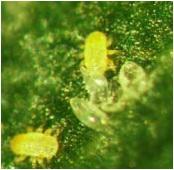 |
| Young hatched larvae of the L1 stage |
 |
| Adult summer generation |
Treatments against the summer generation mainly targeting the eggs and larvae . The eggs are usually treated with agents that operate by stopping chitin synthesis ( diflubenzuron and teflubenzuron ) but here is very important to do a treatment on fresh postponed eggs (egg white), also suffer and eggs postponed shortly after the application of these active substances. It seems that these assets show the same effect as the action of the standard psilicidi that normally use. This is explained by the fact that these funds do not have a negative effect on the natural enemies of pear fleas. However, it seems that the most effective way to fight pear fleas, treatment in juvenile stages (larva stage L1 and L2 ). The main active substances for control of pear fleas today are abamectin and spiridoklofen, classic acaricides. Abamectin is today the main bearer of the fight against fleas and belongs to the group of avermectins produced by bacteria found in soil Streptomyces avermitilis (Lasota & Dybas, 1991). The main activity abamectin, geared toward young larval stages, and only secondarily to adult forms. The best results when doing a go at the stage while the main egg yellow. Abamectin has translaminar activity, and the best effect is achieved if it is added to the mineral oil, as it can then be considerably longer keep the plant. In practice, it often indicates that only one treatment done at the right time against the other, the summer generation could significantly prevent the spread of fleas and keep it below the threshold of economic harmfulness.
Spirodiclofen interferes with the synthesis of lipids in the target group, and later a chemical compound. Original mode of action of the active substance plays a key role in the rotary strategy of defense of pear fleas, along with abamectin, and thus can significantly reduce the occurrence of resistance. The best effect when targets yellow eggs a few days before drank larvae. Mineral oil may enhance the activity of the active ingredient. In terms of lower pressure of this pest and one treatment may work well, while the remaining pests due to reduced population can be solved and predators. But generally speaking, it is still abamektin most effective active ingredient in the fight against pear fleas . New at that could help control the spirotetramat , which has the same mode of action as well as spirodiclofen , except that still shows great effect on fleas that suck on the tips of the summer shoots .
SUMMARY:
On the basis of the above, it seems the best use for the protection of pear fleas integrated approach , which includes the following:
- Monitoring development lifecycle fleas
- Reducing the vigor required the use of agro and pomotehničkih measures (balanced fertilization, growth retardants, trimming roots, green pruning)
- Winter treatment of mineral oils before moving vegetation
- The winter-spring treat some of the pyrethroids at the moment of delay and eggs before they become active natural enemies
- The use of kaolin clay at the time of taking the first egg and then repeated after two weeks (Surround-S)
- The use of insecticides from the group of insect growth regulators on only postponed eggs (white) + the use of mineral oil as a wetting agent
- The first young larvae after flowering solved using Mospilan or Actara in elevated concentration, because in addition to combat fleas and aphids and wasps
- First the following application on the eggs and young larvae should be carried out at the time phase of yellow eggs, shortly before the young larvae, with the help of abamectin (Vertimec, Kraft) + mineral oil
- In the following the adequate protections rotate insecticide based spiridoklofena (Envidor) with insecticides abamectin , to avoid the appearance of resistance + mineral oil
- In autumn it is possible to treat the use of funds based on pyrethroids reduce overwintering populations of pear fleas, while taking care not to destroy the population of natural enemies
- If we go with the mineral oil then do not go with the funds on the basis of captan and ditanona to avoid possible phytotoxicity .

No comments:
Post a Comment
Thanks for your comment