
 In recent months we have witnessed a kind of controversy that was somewhat forced upon the media, regarding the long-term climate forecast in the near and distant future. So therefore we have diametrically opposed notice. Since the arrival of cold winter above average, above average and the arrival of a warm winter.
We have the advocates of the theory of global warming on the one hand and advocates of the theory of entering into a new mini ice age on the other side. I do not want to go into polemics about who is right, nor is it a subject of this article. I recently had an interesting workshop for farmers, organized by the MHS and partners with the theme of time and climate . There were talks about the impact of climate change evident (disorder) on agricultural production in the future.
Increased average mean temperature
According to the processed results of the monitoring stations MHS, it is clear that in the last decade recorded an increase in average mean temperature and the occurrence of extreme drought which have negative consequences on food production. All this prompted me to look into the relevant papers about the possible impact of climate change on fruit production in the future and accordingly presented can hypothetically possible proposals and solutions, in order to mitigate the negative effects of these changes.
The impact of climate change on agriculture
As the fruit species have increasingly introduced in olive from areas with temperate climates in areas with warmer climates, so more and more came to the fore the negative impact of the dry climate of the resting phase, and consequently, on the growth and development of fruit trees in the vegetation and many researchers his research focused in this direction.
For all the internal changes taking place in the plant during sleep, have the greatest influence environmental factors during the period autumn - winter. This resting phase prepares sensitive tissue fruit trees, with no major shocks to complete a period of adverse weather conditions. The temperature has the greatest impact on the initiation and termination periods of rest from all environmental conditions. But significantly affected by light intensity, soil water and plant and apical dominance peak buds. Lang and colleagues have proposed that the standstill period will be divided into three phases:
- Para dormancy (false hibernation)
- Endo dormancy (internal or right to sleep)
- Eco dormancy (organic sleep)
The varieties in temperate climate
To fruit in the spring could freely move in the vegetation and fruiting, one of the three phase mode must pass without shocks. If we take the first example of growing varieties that fruit growers because of its good market feature introduced in the production of the temperate zone in a warmer climate in the area, we come to the following problems:
The varieties in temperate climate have a greater need for the accumulated low temperatures during dormancy and when they come in terms of where they can accumulate a sufficient sum to low temperatures, show the severe shortcomings. These fruits are late with budding and leafing, flowering is weak due to aborting a large percentage of flowers and not uniform, while scrolling is also bad, because many sideways buds can not move in the vegetation. This leads to weak and insufficient fertilization, and the fertilized fruits show deformations in the form and there is not enough krenulih leaf buds to achieve a sufficient volume of leaf to produce good quality and big fruits. Ultimately, this leads to non-profitability and the inability to produce such varieties.
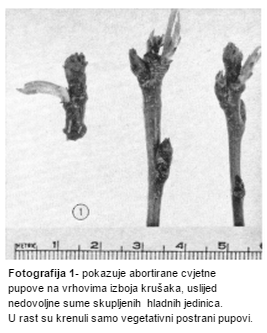
Aborted flower buds
Traditional cultivars grown in warmer climates, through the years have been selected and oplemenjivani, the lower the need for inactive temperatures and did not show or show only minor negative effects due to climate warming, over a period of inactivity.
In drier climates have evolved and agricultural management practices use chemicals that have a role interrupt mode, but the most commonly used combination of suitable cultivars, with chemical methods. These circumstances are still in warmer climates enabled decent production, but with the arrival of all of drier and warmer years in these climates, but notice the first serious problems in the production of apples and pears, for example, but we will discuss that later.
How temperature affects the time of movement buds?
Search trends buds depends on two different temperature processes:
- The accumulation of the necessary sums to low temperatures (up to the level needed to complete phase mode)
- The accumulation of warm units (achieving this amount, buds start to flowering and leafing through)
Hibernate fruit trees begin to leaf drop, and ends by passing juice and the swelling buds. During winter dormancy stops visible growth of aerial parts of the plant, however, then the root system has strong growth. In the winter dormant plant must gather enough cold units sleep (eng. chill units , CU ) and unit growth (eng. growing-degree-hour GDH ), so that in the spring to continue with their normal development.
The need for low temperatures
Demand for cold units vary from variety to variety significantly, even within the clones of the same variety. Also aside vegetative and generative buds have different requirements for the amount of cold units.

Treatment plants
So aside buds require a much greater amount of cold units on terminal buds. This is directly associated with pronounced apical dominance in the terminal buds. This fact gives us the ability to selection of varieties akrotoničnog type of birth (born on terminal buds), create clones that will have very low or medium-low need for cold units.
Also, there is a difference between the kinds of buds. The leaf buds require a lot more cold units of flower buds. Because of this fact, the models to track the moment they emerge from hibernation will need to develop on the basis of studies of leaf buds, because otherwise we would not have sufficient vegetative volume , which would provide sufficient quality and yield.
What are the biochemical processes taking place during sleep?
During sleep mode, several processes in plants takes place simultaneously. Modifies the dynamics of the water regime and carbohydrates, hormone balance, and the content of each component.
Low temperatures are associated with changes in the content of carbohydrates, nucleic acids, amino acids, as well as the level of breathing, which is again associated with the time of opening and the time of flowering buds. The main impact of going through the direct influence of the temperature on the biochemical processes of the plant. The availability of carbohydrates is probably central to the control of growth and development of buds at rest and may be related to the poor quality buds. Starch that has accumulated in the reserve tissue during the growing season, is transformed into soluble sugars during winter dormancy.
This is explained by the fact that it is affected by the accumulation of the lower temperatures, the activity of the hydrolase enzyme increased, so increases the concentration of starch and soluble sugars. Immediately before the movement of vegetation is observed in terminal buds sudden increase and decrease of the sugar content of sucrose starch. Sucrose is transported through the xylem bud and there is hydrolysed to glucose and fructose, which are required as precursors of carbon and energy in the subsequent changes of the substance. The researchers investigated the relationship between carbohydrates, hormones, nutrients, and the formation of flower buds in different fruit species.
It seems that global climate change can significantly affect plant phenology , because temperature affects itself and through interaction with other factors such as fotoperiodizma.Average air temperatures in the last 30 years increased by 0.3 ° C per decade. A good understanding of the impact of these changes on the cultivation of fruit, is of great importance for further development of horticulture. Already have so far been recorded huge economic damage from the impact of the pears in Brazil (Petri et al., 2002).

Buds pears
It is noted that in situations where during sleep have more abrupt jumps temperature of 27 ° C on more, there is a prolongation of the period of standstill in relation to the minor fluctuations temperature (2-3 ° C). The feature small accumulation of lower temperatures and prolonged and poorly synchronized flowering, resulting in the great gap in the size of the fruit during harvest.
Recently, more and more studies dynamics of water in the plant and its buds during dormancy phase, and its impact on the variation in the quality of the buds. It has been found that the phase transition from the plants in the phase endomirovanja ecological mode happens to bound water becomes free water. According to these findings it is clear that the current status of water in the plant has a significant impact on the end of the period of rest and start moving buds.
Models to predict the moment they emerge from hibernation fruit
Most models for odredviđanje completion mode is developed on the basis of monitoring the value of the stone fruits. The first models are summarized value temperature below 7.2 ° C , or between 0 ° C and 7.2 ° C . One of the most famous models of the Utah model , which was developed for peach prof. Richardson and his associates in 1974. The disadvantage of this model was its relative unreliability tracking completion mode apples and pears.
Practical aspects of climate change in sub-tropical areas of cultivation
In recent years we have observed a steady increase in the average temperature, as well as prolonged periods of warmer winter , in temperate climate zones, and in the subtropical zone. This resulted in poor production results, even in varieties that have recently been successfully grown. As already stated, Brazil and New Zealand fruit growers have recorded tremendous damage to pears due to the aborted flowers.
The damage ranged from 60% to 90% as worse flowering, which ultimately resulted in the decline of production . In addition to these direct damage due to insufficient accumulated cold units, the rest of the flowering took place irregularly and delayed, which resulted in the harvest of the fruits of various sizes and reduced quality. One possible solution is certainly develop a quality model for monitoring the impact of temperature , the requirements for cold units, according to the type and position of individual buds, to a greengrocer had a reliable tool for selecting the most appropriate moment for the application of chemicals to break dormancy, and provide more uniform flowering.
You need to constantly introduce new selection of varieties , which have very low or medium low needs for suspicion of cold units. Selectable varieties with akrotoničnim type of birth (born on terminal buds), to take advantage of the fact that the buds that have a more pronounced apical dominance require a much smaller amount of cold units. The plantations of apples and pears gistog assembly, bundling lateral shoots in the horizontal position could have a positive effect unification of the apical dominance in the bud, and as a result have uniform flowering, and better harvesting.
Practical aspects of climate change in temperate areas of cultivation
And our country belongs to the moderate area of fruit cultivation, and unfortunately here in the last twenty years, there are evident changes in the reaction of fruit trees to climate change . As already indicated above, the increase in annual mean temperature and the occurrence of extreme drought in the vegetation, but have made a lot of damage.

Peak flower bud, Idared
Winters are milder last years, but so far most of the varieties that are increasing in production have no direct damage, because in the mildest winter fail to collect, but more slowly, the required sum of cold units. According to research V. Vucetic and B. Krulić, the normal start growing apples in Croatia to be met following condition for cold units: 900 <C <1250th
As long as he collected enough CU, flower and leaf buds are developing normally. If the plant is not expensive enough CU at rest may occur following physical effects:
scrolling delayed , delayed and prolonged flowering , which leads to reduced yields and reducing the quality of the fruit (Lorimer and Hill, 2006). Chemical preparations (hydrogen cyanamide) applied in the spring can partly counteract the effects of lack of collected CU. They can replace the lack of CU 300, but excessive use can cause damage to the buds (Petri et al., 2004). In addition to the CU, it is important to plant expensive and enough heat and enough of the light intensity during the standstill period.
The heat plant assembled expressed through the temperature sum of the temperature threshold 4.4 ° C, call the units increments ( GDH ). When the plant assembled enough CU and GDH, comes to the beginning of the growing season (Rea and Eccel, 2003). In the years where we have a strong medium or severe winter, the first part we have a case that is relatively quickly gather sufficient suspicion of cold units (CU) and when in the second half of winter have above average warming, which has in recent years often been the case, quickly gather and sufficient sum of unit increments (GDH), and our fruit trees before entering the vegetation, and we have a lot better chance of hatching suffers from early spring frosts.
Unfortunately, with the usual cold winter and warm spring normally are less and less, and we are forced to adapt to the new situation. The problem with the earlier flowering can be partially solved with the use of chemical agents that delay flowering and taking certain measures pomotehničkih (pruning) in exactly the target period in summer.

Utah Model
It is also necessary to think of the scenario, if more extended periods of mild winters, ie. The possibility of introducing varieties that have less need for cold units.
In addition to recorded earlier beginnings of vegetation , in the recent period, we note the considerable extension of the growing season . Personally for two years on the varieties Idared in Baranja, a greater and greater percentage of peak flower buds that invading ( retrovegetacija ), and have a direct loss of a certain percentage of flower buds. These increasingly common cases, you might be able to be associated with above-average warm and damp autumn. These are the first indications of possible problems that could occur if the trend of rising temperatures and still continued. We unfortunately we are unable to predict what will be the future, regardless of climate change, but the current findings certainly we can be landmarks and it is necessary to investigate climate change and everything related to it in order to have time to react and adapt to possible new circumstances, without negative effects on production.

No comments:
Post a Comment
Thanks for your comment