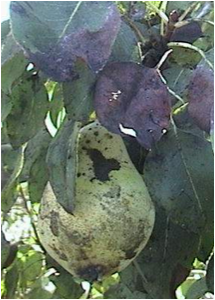
|
Alternaria small apples photographed on the list in 2014 as
a plantation in the area of Posavina |
We all know that
the greatest damage in the
intensive apple production caused all known
scab(scab). But in recent years
appears to us a recent disease called
alternaria . This disease can cause, if not controlled,
a lot of damage , and personally
I predict that it will be only for her to hear in terms of
losses in production, which will be caused by this, our fruit growers
less famous fungus . Symptoms are visible on
leaves and
fruits . The disease attacks
the apples but also
pears . Last year, 2,014 years
personally I recorded
strong attacks Alternaria small, in
all localities where the
holding rainwater over a long period, which led to increased
defoliation of leaves , which ultimately
resulted in the
weaker return
blossoming , as well as
lower and higher quality crops.
Last year I noticed the first symptoms of alternaria in one
orchard pears . I noticed that our most victims varieties
Gala ,
Golden Delicious and
Braeburn, Pink Lady or other varieties if they are in conditions of high humidity and high temperatures show sensitivity. Since you all want
to warn the
danger that the apple production brings
this disease , I decided to publish an
excellent text on this subject and which is the author of our eminent expert in the field of crop protection
Dr. Milorad Subic ., which is hereby
thankthe
excellent article , which gives
an excellent overview of our readers, in order to more closely
acquainted with
this disease .
 |
Symptoms Alternaria fruit on G.Deliciousa
Photo : Sachbereich Ökoanbau, VZ Laimburg
|
Just as I write this, I look at the reports from the
meteorological station , where we can see how in the wider
region of Slavoniafell from
100 to 200 liters of rain per
square meter, and by a further
10 days, metorolozi announce the
dry and hot weather, with daytime temperatures around
25 degreesand these are just
excellent conditions for the development
of this disease, because the evaporation of evil could be
great, and are particularly at risk apple orchards where the retained
excess rain water and where they are grown especially
susceptible varieties . Of the
active substances for combating
alternarijske mottling on
apples according to data from
the FIS , with us is a registered combination (fluopyram + tebuconazole) -
Luna , which is registered and for the suppression of
Septoria on pears (
Stemphylium vesicarium ), which could also become a
significant danger in our orchards
of pears .

 In recent months we have witnessed a kind of controversy that was somewhat forced upon the media, regarding the long-term climate forecast in the near and distant future. So therefore we have diametrically opposed notice. Since the arrival of cold winter above average, above average and the arrival of a warm winter.